Showing posts with label networking. Show all posts

Monday, July 23, 2012

UMBC Day 03 - Baltimore Art Festival, Baltimore Aquarium, and Mezze Restaurant


July 22nd was another surprising day of activities for e-teacher scholars. We started the day with breakfast at The Grits. Next we got into the bus to go to the Baltimore Art Festival. As usual, the bus dropped us at our first destination - the Baltimore Art Festival - and we were told it would pick us up in about three hours. From then on we were on our own. I really like the configuration these group strolls take. We generally depart with a group of friends and change our strolling peers as we walk and get called by someone else or get distracted by our uniqueness of interests. This unintended group arrangement provides an opportunity for a bigger variety of interaction and is itself a very enriching personal and cultural experience.

The Art Festival

photophoto                                          

he 
Apart from the human and interactional side of this excursion, the Art Festival in itself is fantastic. The festival is one the biggest of this kind in The U.S. Part of the downtown area streets are blocked for the event. As you walk up and down you can see lots of interesting works of art. Works of art range from paintings to handcraft and from glass miniatures to installation art. There was even an impressive collection of insect replicas. Besides that, there were food stands with a great assortment of choices in case visitors got hungry. I did and I got myself some smoothie and a gyros. Really a great choice for a Sunday morning.

The Aquarium


photo


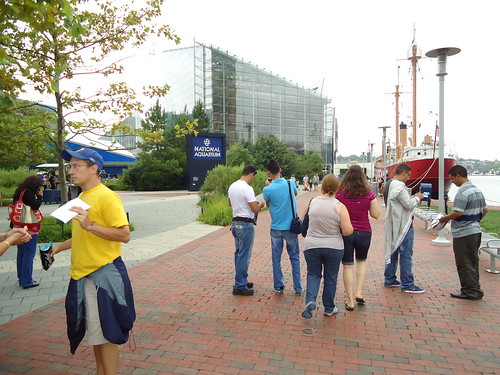
After the art festival we got the bus and headed to the Baltimore Aquarium. Sitting at the harbor area, this is a four-story building displaying a fascinating collection of water creatures in their different habitats, some rain forest insects and frogs and tropical botanic garden. Again we constantly changed our walking, chatting, picturing peers. I personally found it a very enriching educational experience. As I walked with Valentina, she shared very interesting stories related to animals and the discoveries one can make while closely observing animals in general. We talked about how kids and adults as well can benefit of such experiences and develop a deep respect for all species of life surrounding them. I kept wishing I had my English Access students and my nephews with me. It was so interesting that we had to rush to mange to get a glimpse of everything before our bus arrived. The aquarium showed some of us a world that some of us had only seen on television and it allowed us to share our personal stories about the ones that were familiar to us.

Dinner


After so much walk, we felt tired and hungry. So, the next stop was the Mezze Restaurant. For this early dinner we sat in parties of five, six, or seven. On my table we talked about so many things. Some of the topics were: food (of course), our students and schools, vacations, what we watch on television, our native languages and their peculiarities and similarities. Needless to say the food was delicious, and being such an unskilled cook, I could not name all the dishes that we were served. The conversation was fantastic, and to be honest, with such wonderful conversation and conversationalists, I could probably go hungry for another two hours. My roommate Chauki and Hisham, who were fasting, would probably agree with that. This reminds of a scene of one of my favorite movies AI (a project of Stanley Kubrick directed by Steven Spielberg). In this scene the mother is taking the now unwanted boy robot to disposal ground on the woods. The boy robot, unaware of his "adoptive mother's" intentions strikes a conversation. The mother is extremely sad and really does not want to abandon him because she has grown to love the robot boy. It goes more or less like this.

" What will we have for dinner today? " asks the boy robot.
" You never eat." the mother says. He is robot and he can't eat. If he does, he is seriously damaged.
" But I like to sit at the table." Replies the boy robot.

Sunday, June 24, 2012

Where to Publish Students' Work?

Since I started using the web in my classes I have become a big fan of publishing and I have always been proud of some of mine and my students' accomplishments in this arena. In the beginning I started blogging. At first, I wrote blog posts myself and asked students to post comments. I could see that this seemed to be a nice and interesting way of engaging students. It elicited a given structure or lexicon, and got their opinion on a given subject. However, it lacked initiative from the part of learners. I felt that I could not limit blogging to comments from the part of students only. Besides that, I found my posts a little predictable and missing the desirable originally.  To be honest, I started getting tired of listening too much of my own of voice as the conversation initiator.  
Medium_4866638272
photo credit: Βethan via photo pin cc
Once I realized that reducing blogging to students comment was not enough, I moved on to the second stage of my publishing efforts. This stage involved getting my students to create blogging entries themselves. As a result, my class blogs blossomed with creativity. Students used their own drawings and images to illustrate posts. Besides that, I could see that they were more interested in reading and commenting on what their friends had written. Comments were not always written, but they always checked and browsed their peers’ posts. Therefore, there was a change on the cyber landscape. At this point, I also could change my role and started being the one  reacting, giving feedback on my their work. Not only that but I also got some of my online friends to give feedback on my students published content.
However, as time went by, I started realizing that blogging also had some limitations of its own. For example, in a large, prolific group, one easily loses track of content. If you have too many posts, it becomes difficult to keep up with the time line. Posts that are quite recent are not visible and only the most recent ones are displayed on the first page. As result, your audience (students themselves and others) might feel a bit overwhelmed with content. To top it all, as the web evolved, blogging started losing its appeal to younger learners. Their interest moved to platforms that allowed adding peers as friends and all sorts of connections besides mere comments on posts.
It was after realizing that students needed a more connected publishing platform that I went for social networking. So, that is where I am now. I am struggling to find one that suits mine and my students need. Although I really like Facebook, I think it has the drawback of being sometimes too overwhelming for getting an audience to more reflective publishing. Facebook is good to connect a group, but it is limited if you want to teach writing or engage your group in a given activity. I might be wrong, but I think a barrage of posts and updates does not help teaching. Meanwhile I am still looking for a more suitable and "free" social netwoking platform. While I wait, I am using grou.ps. Here is what my students and I have been doing. 


Sunday, May 11, 2008

The Power of Networks for Learning

I have just finished reading an article on how networking can be important for a manager´s career. This article made me think about the importance of networking for educator´s professional development as George Siemens suggested. As a teacher I have learned a great deal from my networks, from being conneted. My network keeps me current of new tools, trends, courses, and events. The list is endless if one stops to think about all the information we get through Facebbok, Yahoo groups, aggregators, blogs, wikis, and so on. As educators, we sometimes get really busy teaching and planning our classes and neglect network building and connecting to our peers in the teaching field. By doing this, we many times stop learning. This last realization made me ask myself a very relevant question: If as educators we do not continue learning, what kind of message are we sending to our students?